
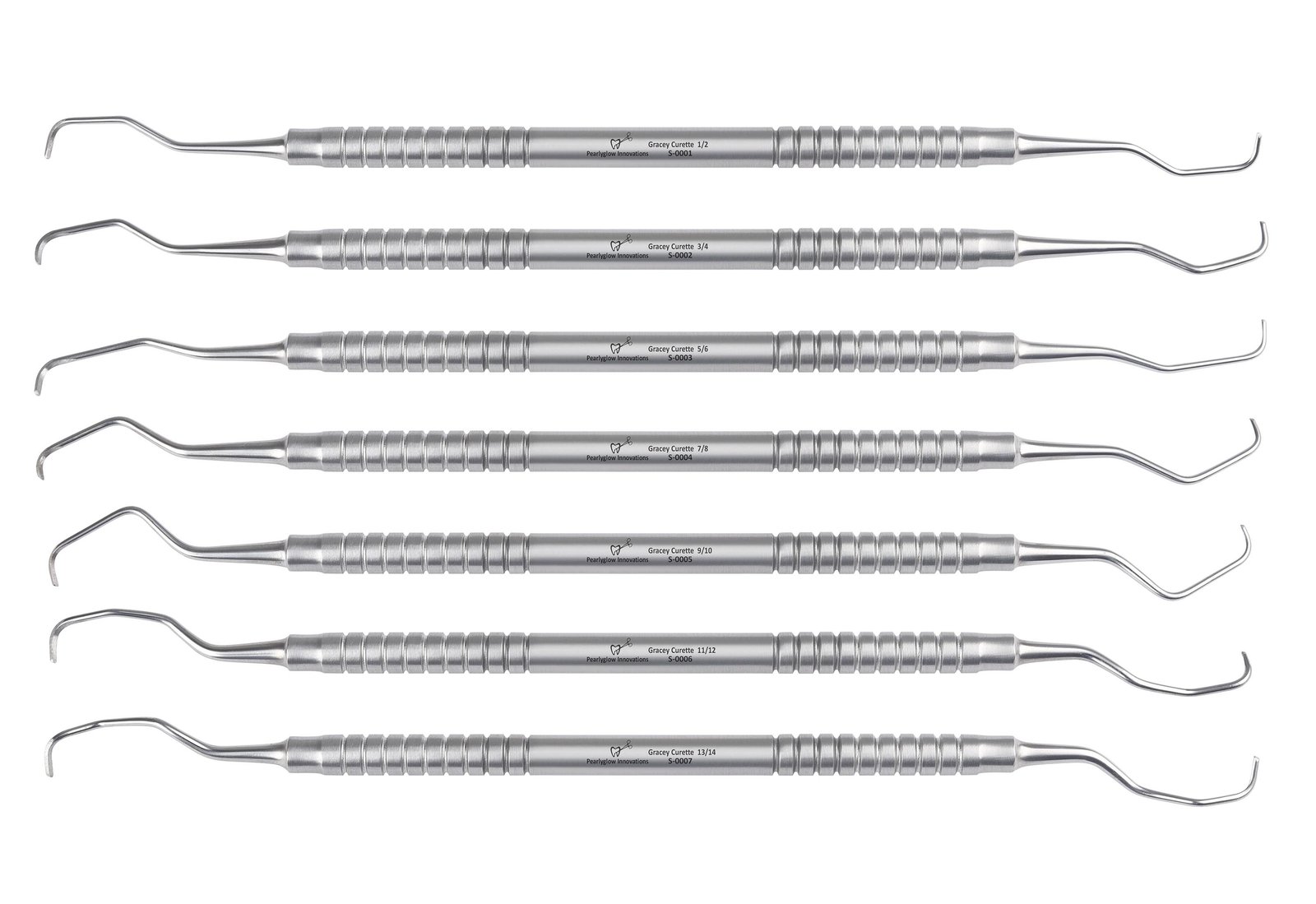
Gracey Curettes Clinical Guide: Root Adaptation, Tactile Control, and Periodontal Precision
Gracey Curettes Clinical Guide: Root Adaptation, Tactile Control, and Periodontal Precision
In periodontal treatment, the dentist’s hand depends on feeling. A curette must adapt to the root surface, move under the gingival margin, and remove deposits without unnecessary pressure.
When the curette is sharp, balanced, and correctly selected, the movement feels controlled. When the curette is dull or poorly designed, the dentist works harder and the patient often feels more discomfort.
Why Gracey Curettes Matter in Periodontal Dentistry
Gracey curettes are area-specific periodontal instruments used for subgingival scaling and root surface instrumentation. Their blade angulation allows better adaptation to specific tooth surfaces.
They are widely used in periodontal therapy because root anatomy is not flat. Furcations, line angles, concavities, and posterior access all require careful instrument adaptation.
A good Gracey curette helps the dentist work with precision rather than pressure.
Understanding the Clinical Role of Gracey Curettes
Gracey curettes are designed for controlled subgingival access. They help remove deposits and support root surface debridement when used with correct technique.
Each Gracey pattern has a specific purpose. For example, anterior teeth, premolars, molars, mesial surfaces, and distal surfaces require different working-end designs.
The dentist should choose the curette according to tooth surface, pocket depth, access, and clinical objective.
Where Periodontal Instrumentation Becomes Difficult
Dentists often struggle when the curette does not adapt properly, the cutting edge feels dull, the handle requires too much gripping, or tactile feedback is weak.
In deeper pockets or posterior regions, access becomes more demanding. If the curette does not match the anatomy, the dentist may apply extra pressure or make repeated strokes without efficient deposit removal.
That increases fatigue and reduces treatment efficiency.
Blade Design and Root Adaptation
The blade is the heart of the curette. Gracey curettes have an offset blade design that allows area-specific adaptation.
Correct blade adaptation helps the dentist maintain contact with the root surface while reducing unnecessary tissue irritation.
Poorly finished or badly shaped blades can reduce control. A blade that is too dull or poorly maintained requires more pressure and can make instrumentation less efficient.
Sharpness and Tactile Feedback
Sharpness is not only about cutting deposits. It is also about reducing force.
A sharp curette allows the dentist to make controlled strokes with better efficiency. A dull curette makes the hand compensate with pressure.
Tactile feedback helps the dentist identify calculus, root irregularities, and surface changes. If the instrument does not transmit sensation clearly, the dentist loses clinical information.
Handle Design and Dentist Comfort
Periodontal procedures involve repeated strokes. The handle should allow a stable grip without excessive squeezing.
A balanced handle can reduce fatigue and improve control during long appointments. Poor handle design can increase strain in the fingers, wrist, and forearm.
Dentists should consider ergonomics seriously, especially in daily periodontal practice.
What Dentists Should Check Before Choosing Gracey Curettes
Check the Gracey pattern
Check blade sharpness
Check blade angulation
Check working-end finishing
Check handle grip
Check instrument balance
Check stainless steel quality
Check autoclavability
Check ease of cleaning
Check long-term maintenance needs
Selection Mistakes to Avoid
Using one curette for every surface
Working with dull curettes
Ignoring blade angulation
Applying excessive pressure
Skipping sharpening or replacement
Choosing uncomfortable handles
Ignoring posterior access requirements
PearlyGlow Clinical Connection
PearlyGlow Innovations Pvt. Ltd. develops, designs, innovates, prototypes, mass-produces, and supplies dental instruments and dental equipment for modern clinical dentistry.
PearlyGlow periodontal instruments are developed with attention to root adaptation, tactile control, handle comfort, stainless steel quality, autoclavability, and dependable daily performance.
The purpose is to support dentists with instruments that feel practical during real periodontal procedures.
FAQs
What are Gracey curettes used for?
Gracey curettes are used for area-specific subgingival scaling and root surface instrumentation.
How are Gracey curettes different from universal curettes?
Gracey curettes are area-specific, while universal curettes are designed for broader use on multiple surfaces.
Why does curette sharpness matter?
Sharpness supports efficient deposit removal with less pressure and better control.
Can Gracey curettes improve root adaptation?
Correctly selected Gracey curettes can help improve adaptation to specific root surfaces when used with proper technique.
Are Gracey curettes autoclavable?
Quality stainless steel Gracey curettes are designed for repeated sterilization when maintained correctly.
Explore PearlyGlow Gracey curettes and periodontal instruments for root adaptation, tactile feedback, ergonomic handling, and dependable sterilization performance.
Periodontal care depends on diagnosis, technique, patience, and the ability to feel the root surface clearly. The right curette helps the dentist work with more precision and confidence.
Better Grip. Better Control. Better Clinical Confidence.